Question 1: Two Sum
Before you start: Make sure you’ve selected the Workshop Agent in GitHub Copilot Chat. Open QUESTION-1-START-HERE.md in the question-1-two-sum folder and keep it open while you work. This loads the AI context GitHub Copilot needs to help you effectively.
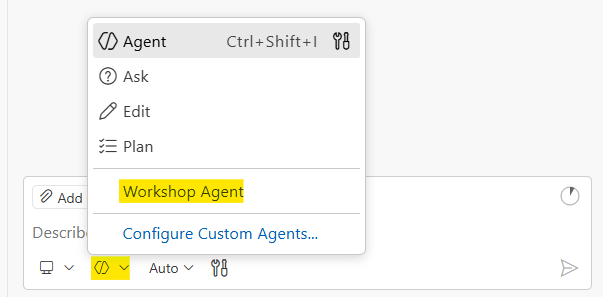
Model tip: For best results, select Claude Sonnet 4.5 from the model picker in Copilot Chat. If you run out of premium requests, switch to Raptor mini or GPT-5 mini, which are free and unlimited.
This problem is based on LeetCode #1: Two Sum.
Problem Statement
This is a classic algorithm problem. Given an array of integers nums and an integer target, return the indices of the two numbers that add up to target.
You may assume that each input would have exactly one solution, and you may not use the same element twice.
You can return the answer in any order.
Examples
Example 1:
Input: nums = [2, 7, 11, 15], target = 9
Output: [0, 1]
Explanation: nums[0] + nums[1] = 2 + 7 = 9
Example 2:
Input: nums = [3, 2, 4], target = 6
Output: [1, 2]
Explanation: nums[1] + nums[2] = 2 + 4 = 6
Example 3:
Input: nums = [3, 3], target = 6
Output: [0, 1]
Example 4 (Negative Numbers):
Input: nums = [-1, -2, -3, -4, -5], target = -8
Output: [2, 4]
Explanation: nums[2] + nums[4] = -3 + -5 = -8
Constraints
- 2 <= nums.length <= 10^4
- -10^9 <= nums[i] <= 10^9
- -10^9 <= target <= 10^9
- Only one valid answer exists
Workshop Workflow
1. Plan
Understand the problem before touching code. Think about edge cases and assumptions:
- Can the array contain negative numbers?
- What if the array is empty or has only one element?
- Can there be duplicate values?
- Do I return indices or values?
Then design your approach with Copilot:
- What data structure would help you quickly check if the number you need has already appeared?
- What’s the time complexity of a brute force approach?
- Can you do better than O(n²)?
2. Prove
Direct AI to write your solution in the question-1-two-sum/ folder. Before running anything, predict what the output will be. Then run the tests and verify your solution works.
3. Explain
Be ready to articulate:
- Time complexity
- Space complexity
- Why you chose this approach
Deliverables
Your solution goes in solution.py in the question-1-two-sum/ folder. Open that file and write your code there.
Tests are already written in test_solution.py. Once your solution is working, run them with:
python test_solution.py
Hints
Only look at hints if you’re stuck!