Created and maintained by Segun Akinyemi
This site is always available at aka.ms/nocap
A practical, continuously updated collection of resources on AI and its impact on tech careers. Answers to the questions I keep getting asked, plus the skills, tools, and courses to actually go do something about it. Built by a software engineer who uses AI every day at work and is tired of watching people panic.
Quitting programming as a career right now because of LLMs would be like quitting carpentry as a career thanks to the invention of the table saw.
Simon Willison, co-creator of Django
One of the most respected voices on AI-assisted software development. Read his blog.
Hello there! I'm Segun Akinyemi, a software engineer at a company you've probably heard of. This site exists because I got tired of watching people get misled into thinking they should quit computer science, give up on software engineering, and go sit in a hole while waiting for AI to destroy the world.
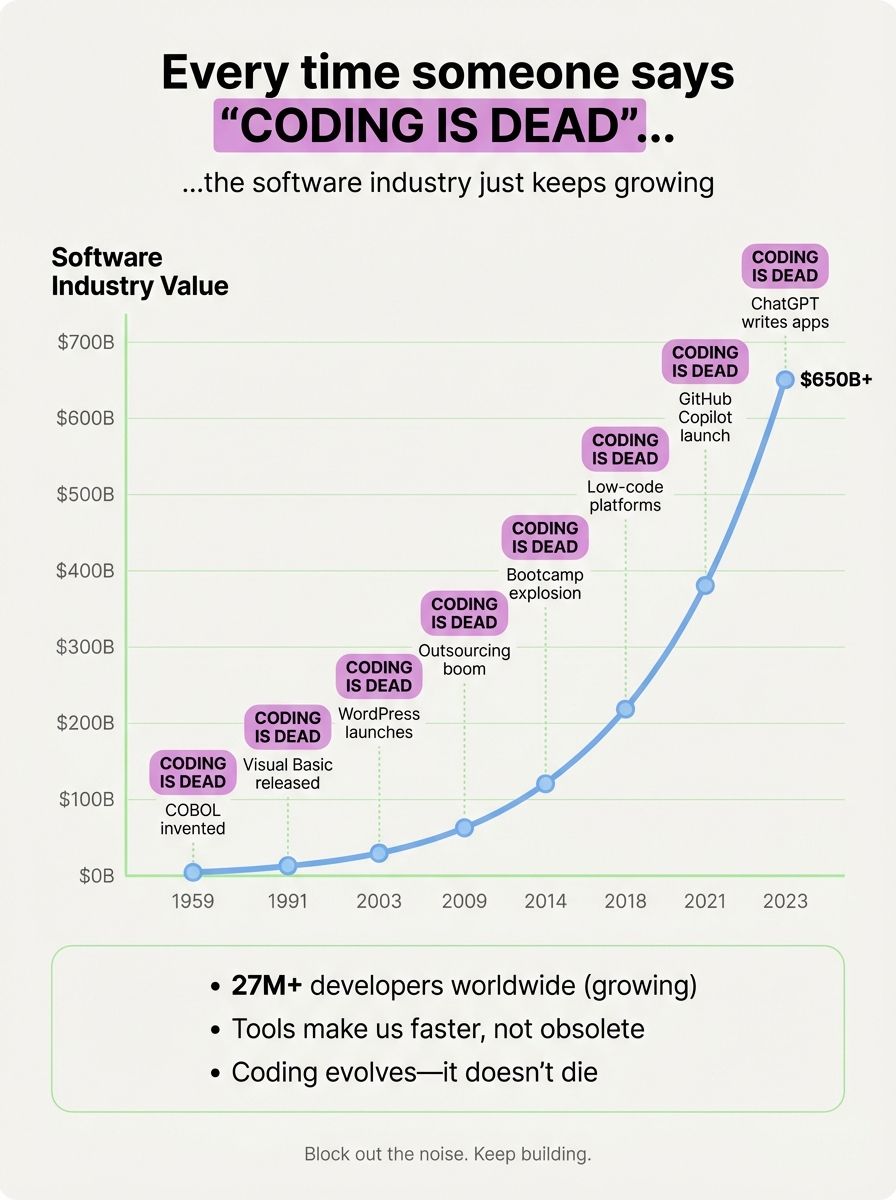
At work. At events. At conferences. On LinkedIn. In emails. Everywhere I go, people ask me the same thing about AI's impact on the software development industry. It never stops. Most of the time it's some version of "is your entire career field gone now because AI writes code?" That's like asking if mathematics disappeared when calculators were invented, or if accounting died when Excel came out. The tool changed. The work didn't go away. It never does. Coding manually is dead, but software engineering isn't.
Even before AI, people generally have never understood what software engineers actually do. It's always been a lot more than just writing code. The confusion these days is totally understandable if you only listen to hype peddling CEOs, journalists, and influencers who need clicks and investors. But if you listen to the technical practitioners, the people who actually build the stuff, it's a very different story.
I keep seeing students, job seekers, and new grads ask whether they should quit their whole life and move somewhere rural to become a farmer. Why? Because some money loving, non-technical, shareholder groveling CEO said AI is going to replace all white collar jobs. Or some AI CEO claiming software engineers will be replaced in months, the same guy who's been saying this for years while his company aggressively hires software engineers.
Those kinds of statements exist to convince investors that the billions being spent on data center build out is worth it. Never mind that many of their AI products flat out suck. It's insane. This site exists to combat AI hot take nonsense and thus calm anxieties. AI is making CEOs delusional, and they'll say anything to avoid looking like they're falling behind, even when they clearly don't understand what they're talking about. They're not leading. They're following each other off a cliff while dragging public perception with them.
I keep this site updated. Connect with me on LinkedIn.
Before you doom spiral about AI's impact on software development, read these. Short answers here, links to the longer essays if you want depth.
Mostly no. The layoffs you're seeing aren't because AI did those people's jobs. They're because AI is ridiculously expensive to run. Companies need to free up cash for data centers, GPUs, and compute infrastructure, so they're cutting headcount to fund the build out. Tech giants like Google, Amazon, Meta, and Microsoft are cutting to fund GPU purchases, not because AI replaced those workers. Their revenues are growing. Their stock prices are climbing. They're firing people to reallocate money from payroll to compute. You can track tech layoffs here.
As Harvard Business Review put it, companies are laying off workers because of AI's potential, not its performance. Some CEOs are just using AI as a convenient excuse for cost-cutting. Case in point: Block (Jack Dorsey's company, he also founded Twitter) cut nearly half its workforce and blamed AI, but current employees told The Guardian that 95% of AI-generated code still needs human fixes and the real motive was posturing for investors. Even Sam Altman, CEO of OpenAI (creators of ChatGPT), admitted that some companies are "AI washing" their layoffs. Matheus Lima said it best:
Will some companies use AI as an excuse to cut headcount? Absolutely. Some already have. There will be layoffs blamed on 'AI efficiency gains' that are really just cost-cutting dressed up as something else.
Matheus Lima, AI Can Write Your Code. It Can't Do Your Job.
Don't let headlines scare you out of a career.
No. The industry is not dying. The jobs are not going away. But things are changing. Read these and form your own opinion. For my full takes, read Times Are Changing: Coding Is Dead, Software Engineering Isn't and On the Nature of AI in Tech Careers.
Not just what matters, but exactly where to go learn it. Every area listed below is still relevant in the age of AI coding. Every resource below is free. These are listed in a rough progression, start at the top and work your way down.
At some point in school, everyone got to use a calculator. Yet, some kids still failed the test. If you don't understand the material, a calculator won't save you. You won't even know what to type in. AI in software development works the same way. You can vibe code your way to something that works, but without real understanding, you'll never build anything that lasts. Employers don't pay for vibes. If you want to get paid, learn the fundamentals.
Segun Akinyemi, creator of this site. Shameless self-quote.
The foundation everything else builds on. Programming, algorithms, how computers work. If you skip this, you can vibe code all day, but you won't be able to pass a technical interview to get a real software engineering job. There are no shortcuts to mastery.
Take these Harvard CS50 courses and you are set. Seriously. They are free, world class, and they will give you the knowledge you actually need. Everything else on this page becomes 10x more useful once you have these basics down.
Also check out The Missing Semester from MIT, which covers the practical tools (shell, Git, debugging, dev environments) that CS programs skip. It was updated in 2026 with AI tools now folded into every lecture.
Been coding in Python with the help of LLMs. That would have been impossible without the grounding that CS50 gave me.
u/extopico, a CS50 student who came back two years later to confirm the fundamentals paid off.
How you track changes to code and collaborate with others. With AI writing code for you, version control has never been more important. You need branches, you need backups, you need to stop AI from blowing away your codebase.
The moment you're on a team with other developers, if you don't understand Git, you cannot function. Merge conflicts, rebasing, cherry-picking. You don't have to memorize terminal commands. GUI tools like the one built into VS Code work great. But you have to understand what's happening under the hood.
How data is stored, organized, and retrieved. AI has not made database knowledge obsolete. It has made it more important. AI retrieval systems (RAG, vector search, agentic queries) all depend on well-designed databases. SQL is everything.
Application Program Interface. How software systems talk to each other. An MCP server is only as good as the API behind it. Without APIs, AI literally cannot do any of the agentic stuff people want. Good API design is critical for efficiency, cost, and preventing AI from touching what it shouldn't.
How you know your code actually works. This is exponentially more important now that AI writes code. "I told AI to make the button blue and I see it's blue" is not testing. Real software has thousands of invisible behaviors that break silently. You need automated tests to catch them.
Continuous Integration, Continuous Deployment. Automating the process of testing and shipping code. The easiest way to get started is GitHub Actions. At work you'll use whatever your company has (Azure Pipelines, Bitbucket Pipelines, Bamboo, Terraform, Jenkins, whatever), but GitHub Actions lets you practice right now without needing an enterprise job.
Choosing architecture and components to meet a goal under constraints: reliability, security, cost, performance, maintainability. This includes understanding how computers communicate over the internet. Networking, DNS, HTTP, load balancing. None of that went away because of AI. It still matters, no be small.
"There is no cloud. It's just someone else's computer." AWS (Amazon Web Services), Azure (Microsoft's cloud), and GCP (Google Cloud Platform) are the big three. Each has hundreds of products, each complex enough to build a career around. There is no such thing as "knowing" a cloud platform. It's a continual learning process. Start with the fundamentals certificate for whichever one interests you. If you're unsure, go with AWS. It was the first major cloud provider, it's the biggest, and the skills you learn there transfer to Azure and GCP.
AI Engineering is the evolution of software engineering. You're not building the models. You're taking them and building with them. RAG, MCP, vector databases, embeddings, context engineering, model evaluation. This is the capstone. Everything above feeds into it.
General purpose learning platforms and free student perks beyond the specific resources listed above.
Most big tech companies offer free credits, tools, and courses to students. Take advantage of all of them.
These are the ones that matter. Don't chase every hot new tool from a startup that'll be acquired by big tech in six months.
The IDE. Everyone uses it. I mean, even Cursor and Antigravity are just forks of VS Code. The industry isn't leaving VS Code. Investing in being a power user is time well spent.
Get VS CodeIt's built into VS Code and GitHub. Like Thanos, it's inevitable. Copilot works across many surface areas: VS Code Chat, Web Chat, CLI, Cloud Agents, and more. Free via the Student Pack.
Try CopilotTerminal-based AI coding assistant from Anthropic. Works with any IDE. Nearly every big tech company is funding Anthropic in some way, so this product has staying power.
Try Claude CodeOpenAI's coding agent. Cloud-based, reads your full repo, works in a sandbox. From the people who started the whole AI wave with ChatGPT.
Try CodexGoogle's terminal-based AI coding assistant. Works with any IDE. Backed by Google's Gemini models.
Try Gemini CLIGoogle's AI-native IDE. A full development environment built around Gemini, not just an extension bolted on. Also a VS Code fork.
Try AntigravityThe tech community lives on LinkedIn, Twitter, Reddit, and Hacker News more than TikTok or Instagram. These are the people and orgs actually worth paying attention to.
The voices worth listening to in software engineering don't post on TikTok, Instagram, Snapchat, Reels, or Shorts. They're nerds. They write. If you want the truth, you must read.
Segun Akinyemi, creator of this site. Shameless self-quote.
I keep a curated reading list of the best articles on software engineering, AI engineering, the impact of AI on tech jobs, industry trends, career advice, and more. It gets updated regularly. If you read all this, you'll realize everything I know I just learned from others. There's nothing new under the sun!
Browse the Reading ListIf any of this was helpful, stay in touch. I write about AI, software engineering, and tech careers regularly.
Given Naruto, Bleach, One Piece, Dragon Ball Z, and Pokémon, which do you consider to be the Big 3 of anime and why?
Note that My Hero Academia, Jujutsu Kaisen, Attack on Titan, and Demon Slayer are from a different era. We're talking the OG animes that broke through and made it cool to watch anime in America, whereas it used to get you bullied in school, especially as a black kid...speaking from experience 😅. Send me your answer on LinkedIn.
Also, if you've ever wondered why so many Black men love Naruto, that article explains it perfectly. And if you've ever noticed that one could draw some Christian narratives from the series, you're not alone.