AI Engineering is a term that’s demonstrated staying power in the fast moving hype-filled world of AI in software engineering. Seeing as our attention spans are collectively cooked by social media these days, I won’t linger. Here it is.
AI Engineering is the discipline of building reliable software on top of AI models.
Credit where credit is due, this definition is inspired by AI Engineer and Chip Huyen’s AI Engineering book. I’m sure you can find other definitions online that differ, but this one is short, sweet, and easy to understand, so I’m sticking with it.
An Aside: To nitpick, you might think to replace “AI models” with “LLMs (Large Language Models)”, but that would rule out SLMs (Small Language Models), World Models, and Decision Models, which are all rising in popularity and used to build software. So, yeah, AI models it is.
Isn’t That Just Software Engineering?
Now if you’re like me, you might be going, wait…from that definition, I mean isn’t that just software engineering? Why would you need a new term for that?
Well, first let me say, I like the way you think.
I agree, what’s being called AI Engineering is just Software Engineering. AI models are software, we take that software and make stuff with it. That’s Software Engineering, or Software Development (there’s no widely accepted difference between those terms, anyone telling you otherwise is being either pedantic or pretentious).
That said, the distinction provided by AI Engineering is valuable when you consider that AI models are inherently non-deterministic.
Back in the day, if we wanted to write a program to read and respond to emails, it’d go something like this.
- Scan emails
- Find an email from such and such person with such and such keywords
- When that email is unread then…
- Grab a static email template
- Replace placeholder values with live values from the database and current date/time
- Reply to the email
You see that? That right there my friends is…
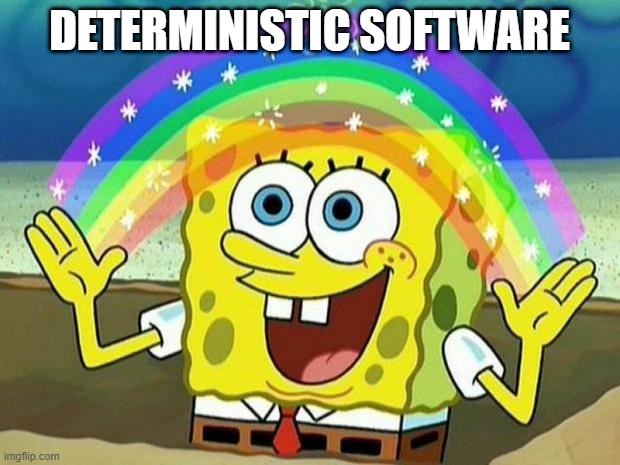
Good, plain, boring, deterministic software that you could trust to do the same thing every time. And if it didn’t, it was because of a logical flaw in the written instructions that you could track down and fix, sometimes with help from an old friend.
An Aside: For the kiddos out there, we used to call those written instructions “code”. Now we call them “prompts”. But if prompts are now our written instructions for computers, are they not a new form of code? Also, if a tree falls in the forest with no one around to hear it, does it make a sound? Think about it 🤔
But this new software? This new non-deterministic software? Totally different. Here’s what that same email workflow would look like today with AI.
- Choose your AI tool (Claude, ChatGPT, Gemini, Microsoft Copilot, GitHub Copilot, etc.)
- Make sure it has an automations feature (most do)
- Write a prompt, “When I get an email from such and such person and I haven’t read it yet, respond and just tell them something that makes sense for what they sent me”
- Trust the AI model to understand what you meant and send good responses
- If it sends a bad response, update the prompt from Step 3 (or switch the model to something more
expensivepowerful)
Do you see how different that is? You’re trusting the AI model to understand your plain language instructions despite knowing it doesn’t actually understand you. Not the way a human would. It’s an “it”. It’s not alive.
It pains me to say this, but with LLMs, we’ve reduced human language to a math problem. Words mean something to you because you’re a different kind of AI, Authentic Intelligence. Words mean nothing to computers.
We’ve taken the words in the English language, derived patterns from how often they appear next to each other, and assigned numbers to those patterns. And bam, now you have a computer that can talk as though it were one of us. That’s an aggressively oversimplified explanation of how LLMs are created, so check this out for a better version.
With all this in mind, it makes sense that we decided to give a distinct name to the field of “making AI models behave consistently within other kinds of software while keeping their core benefit of inferring intent”.
The Rise of the AI Engineer
If you’re thinking “oh well, since AI models can write code, it must be easy getting them to play nice with other software”…look at Copilot. Really. Look at Copilot. It’s not easy, at all!
Making AI models behave consistently for consumers is already kind of hard, but a bunch of companies have figured it out. OpenClaw, Meta Muse, OpenAI Dots, and Claude Duet are the personal assistants that take over your device and do life for you 😟. But it’s even harder when it’s more than one person’s life. Making AI models behave consistently (dare I say…deterministically?) is hard. Really hard.
So much so that Microsoft, Google, Amazon, Meta, and other tech companies have started embracing the job title AI Engineer.
It was coined in this popular 2023 article from Latent Space, which went on to catch fire in Silicon Valley and win the approval of some big names. Three years later, the big corporate companies are on board. Making AI models behave consistently is worth a new field name, AI Engineering, and a new job title, AI Engineer.
LinkedIn has the data to back it up. Their 2026 Jobs On the Rise report lists AI Engineers as the top role, notably distinct from AI/ML Researchers coming in at 5th.
What AI Engineering Isn’t
I’m going to try a meme reference that I suspect precious few of you will get, but here I go. We now know what AI Engineering is, so here’s what it isn’t.
🎶🎶🎶
- Machine Learning is not AI Engineering (nope).
- Prompt Engineering is not AI Engineering (nope).
- Data Science is not AI Engineering (nope).
- Vibe Coding is definitely not AI Engineering (nah).
🎶🎶🎶
And for good measure, College Park is not Atlanta. Sorry, not sorry.

Training models from scratch is Machine Learning. The people who do that usually have PhDs and are really good at math. AI Engineers are akin to Software Engineers, and at most companies, they still have the job title Software Engineer. They were tasked with “hey, add a chatbot to our website” at some point, and at that moment, they became an AI Engineer in everything but name.
Typing clever prompts into a chat box and hoping for the best is the now dead field of Prompt Engineering, superseded by Context Engineering.
What’s Next
The big challenge of making software with AI is unpredictable outputs. The model is only one part of the larger system that goes into making good software. If you’ve heard of Harness Engineering, that’s a subdomain of AI Engineering, just like how frontend and backend development are subdomains of Software Development, not their own separate thing.
So yeah, that’s AI Engineering. Here are some other popular terms that I plan to explore in future blog posts, and they’re almost all just subdomains of AI Engineering.
- Context & Context Window
- Context Engineering (and the death of Prompt Engineering)
- Harness Engineering
- Loop Engineering & Ralph Loop
- Agentic Engineering
- Graph Engineering (a.k.a. Agentic Workflow Orchestration)
- Agent Skills
- Custom Agents
- Custom Instructions
- Agent Evals
- Agent Hooks
- Agent Plugins
- AI Agent (I guarantee we all don’t have a shared definition of what an Agent even is)
- Agent Squad/Squads
Subscribe to my blog if you want to stay up to date! And check out my MCP vs RAG post to learn more about some other popular terms.