The amazing site Don’t Paste the AI captures what I’m saying here more succinctly. It explains why it sucks when someone sends you something as though they wrote it, but it actually came from AI. I highly suggest checking it out. You could even send it to the next person who pastes a wall of AI-generated text into your messages. And if you really want to be feisty, you could send them this more explicit version.
You Write For Humans
When you send someone a text, do you want them to read it? I mean, yes, right? You wrote it for them. They’re the intended recipient. Of course you want them to read it.
There’s some message, some meaning, some knowledge, some emotion that you mean to convey in your writing. This is obvious. You know this. I know this. We all know this.
But what happens when someone sends you something they didn’t write? That wasn’t even written by a human? At least ghostwriters, who’ve been a thing forever, used to be human. These days with AI, who knows?
After seeing how some people are using AI to write personal messages, from texts and emails to messages on TikTok, Instagram, Snapchat, Facebook, WhatsApp, Teams, Slack, Tinder, Bumble, Hinge, Discord, and who knows what else, I’m starting to wonder whether we’re all on the same page about what I thought was common sense.
When you write, you want people to read it.
You write for humans.
So, if you didn’t write it, why should I read it? Why would I bother to read something you couldn’t be bothered to write?
Your Words Matter
We’ve crossed the Rubicon. People are sending other people AI generated messages, and on the receiving end, it’s not always being noticed, because LLMs have gotten better, and companies like OpenAI and Anthropic are pushing the boundaries of how much they can handle for you. For example, ChatGPT can now read, draft, and send Apple iMessages on your behalf.
This 💩 is bananas, B-A-N-A-N-A-S.
This is NOT a good thing. I don’t like it, and I’m not alone.
There’s a great article going viral right now in the tech community that calls out how not very cash money it is to pass off AI generated text as your own.
It’s a great short read. Here’s another good one on a similar theme.
Their point and my point are largely the same. You write because you want people to read it. If you didn’t write it, why should I read it? If it wasn’t important enough for you to write, why should it be important enough for me to read?
Bring Back Pen Pals
I find myself longing for the days when people wrote letters to one another. Bring back pen pals. I’m partial to a good rom-com, particularly from the 90s and early 2000s (less raunchy, more wholesome), and You’ve Got Mail is one of my favorites.
While Meg Ryan and Tom Hanks weren’t writing physical letters, they were digital pen pals, with each of their unique voices shining through their emails. Which eventually led them to romance, despite their differences.
Can you imagine a version of that film where each side used ChatGPT to compose their emails? It wouldn’t work! The love, the romance, the connection, it was found in the nuances of their literary voices. Buried in words they wrote themselves.
Now, to be fair, both characters asked people around them for feedback on their emails. Which today is like showing a text to a friend to make sure you don’t sound too desperate or clingy, and then maybe accepting a suggestion or two. But does that make the text any less you? No! Having an editor is fine. Outsourcing the writing altogether, then putting your name on it, is not.
An Aside: If you haven’t seen You’ve Got Mail, go watch it. You’ll be happy by the end. You just smile the whole time and wish real life worked like that. Then go watch Sleepless in Seattle for another Meg Ryan + Tom Hanks pairing. You’ll also be happy by the end, as long as you can suspend your disbelief a bit during the final act.
For Whom Do We Toil?
What is the point of writing? Of communication? What sense does it make to send someone something you didn’t write as though it came from you?
It’s one thing in a formal setting like work or public speeches or even books from published authors with teams of editors, but for us everyday people…
My brother in Christ, why are you sending me AI generated messages? Did YOU even read it? And even if you did, why did you generate it to begin with? You can’t just text me yourself?
 Are you okay? Are you mad? You dey craze?
The nerve, the audacity, the unmitigated gall, it takes for someone to outsource the hard work of writing, then expect someone else to do the cognitive work of reading, it’s blasphemous!
An Aside: The only maybe defensible excuse for doing this in direct messages is writing in a non-native language. In that case, yeah. I totally would just to make sure I didn’t sound silly. But if you’re speaking your native tongue, what are you doing?
This all leads me to some more great articles.
Tom Bedor - If You Are Asking For Human Attention, Demonstrate Human Effort
Bedor makes several great points with a specific focus on our shared profession of software engineering.
But for a more general take, there’s this:
That one is so very well written. Bret Stephens is firmly in the anti AI camp, which I’m not, but I mostly agree with him about AI’s role in writing. He says it should have no role at all. I think its role, if it’s to have one at all (you don’t need it!), should be minimal, similar to tools like spellcheck or Grammarly.
AI Transparency
Thankfully, some platforms are doing stuff to help address this problem. Substack now lets readers check whether an article was AI generated, and LinkedIn lets users report AI slop posts.
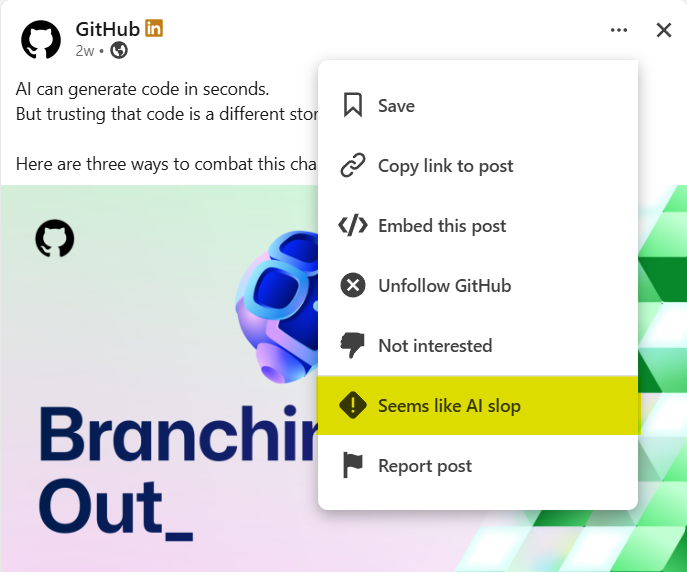
If you’re on LinkedIn, please use that button expeditiously. Do your part to make the Internet a better place. A place for humans.
And with all this in mind, as inspired by Armin Ronacher’s AI Transparency Statement, I’ve written my own.
Check out my AI Transparency Statement.
It now has a dedicated place on this website’s footer and among the buttons at the end of every post. Trust matters. If you’re a writer or content creator, be clear with your audience about how you use AI. Don’t wait until you get caught peddling slop to decide honesty is worth having a policy for.